 listicle
Audio Erotica Apps: Browse by Mood, Not Tags (2026)
Table of Contents
- Why Generic Tags Fail and Mood Browsing Works
- The Best Audio Erotica Apps for Women in 2026
- Independent Audio Erotica Platforms and Why They Matter
- Mood-Based Search Functionality: A Deep-Dive
- Technical Audio Quality: What to Listen For
- Privacy-First Usage: Protecting Your Listening Habits
- Neurodivergent-Friendly Listening and Accessibility
- Pricing, Subscriptions, and Free Options
- Content Variety and Genre Diversity
- Frequently Asked Questions
Last Updated: September 22, 2026
Why Generic Tags Fail and Mood Browsing Works
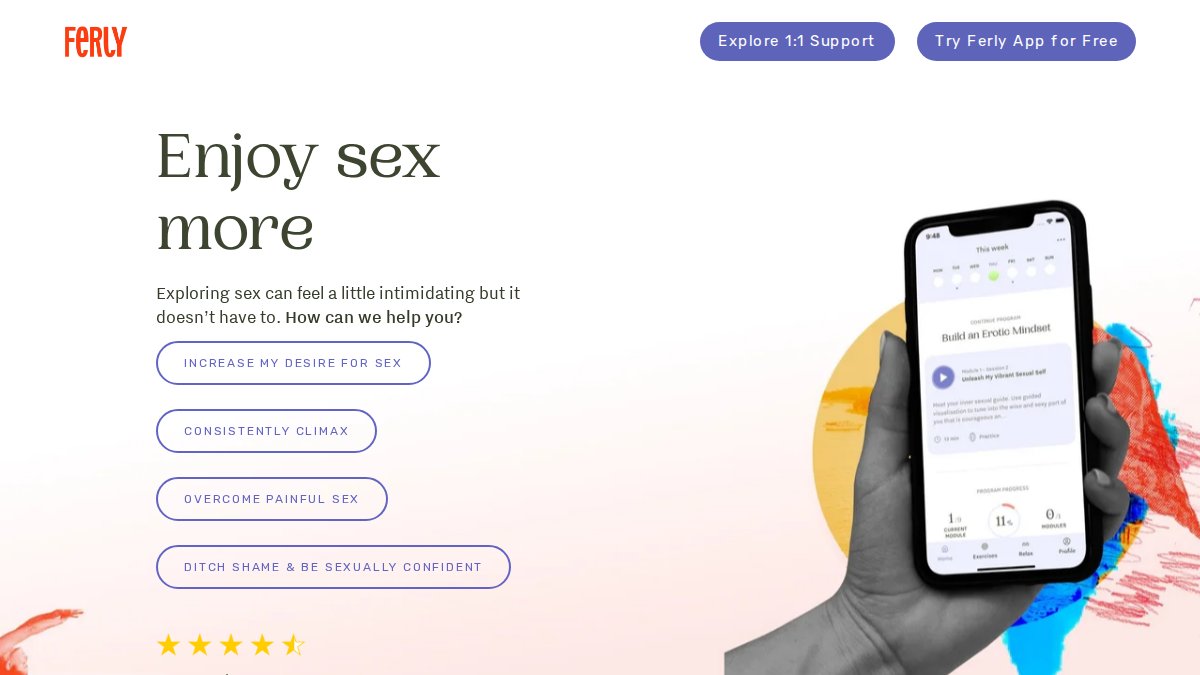
Generic tags describe what a story contains, not how you want to feel. Search "boss romance" and you get every boss romance in the library, from light banter to something much darker. Audio erotica apps are starting to fix this, and hush is built around mood-first discovery rather than rigid tag trees.
The Problem With Rigid Genre Tags
Tags are a filing system, and filing systems assume you already know what you want. That works when you're re-listening to a favorite. It falls apart at 10pm when you just want something that winds you down.
Tag systems also reward volume over fit: the more tags a story carries, the more searches it shows up in, so creators tag broadly. You end up scrolling past dozens of near-misses to find one that lands.
How Mood-Based Filtering Changes Discovery
Mood-based filtering flips the question. Instead of "what's in this story," you answer "how do I want to feel right now," and the catalog narrows from there.
That shift matters for a few practical reasons:
- It removes the guesswork from browsing when you're tired or stressed
- It surfaces voices and writers you'd never find through tag searches
- It works even when you can't name the exact scenario you're in the mood for
- It pairs naturally with genre when you do know what you want
Think of mood as the front door and genre as the hallway.
The Best Audio Erotica Apps for Women in 2026
The best audio erotica apps treat discovery, privacy, and creator pay as core features. Mood browsing is the clearest dividing line: some offer it as a real navigation system, others bolt mood labels onto a tag search.
Quick Comparison: Mood, Privacy, and Pricing
| App | Mood Browsing | Free Tier | Privacy Setup | Best For |
|---|---|---|---|---|
| hush | Yes, mood-first | Yes | Ad-free, no ad tracking | Mood-based discovery |
| Ferly | Yes, theme-based | Yes | Subscription-based | Wellness plus erotica |
| Tempt | Trope and spice level | No | Subscription-based | Granular filters |
| Sensual | Limited | Yes | Subscription-based | Serialized romance |
| Audible | No | No | Account-based | Mixed audiobook libraries |
hush: Mood-First Browsing With a Creator-First Model
hush is a library of independent audio erotica built around how you want to feel rather than rigid tags. Mood isn't a filter bolted on top; it's the primary way you move through the catalog.
hush pays 70% of subscription revenue directly to the writers and voice actors behind the stories, for listeners who care about supporting independent creators, that's the whole point.
Other things that stand out:
- Ad-free listening, so nothing interrupts a story
- Editors refresh the library weekly
- One flat monthly fee, cancel whenever
- A free tier to test before committing
The honest limitation: it's a curated library, not an endless one. hush trades volume for fit.
Ferly: Audio Erotica Meets Sexual Wellness
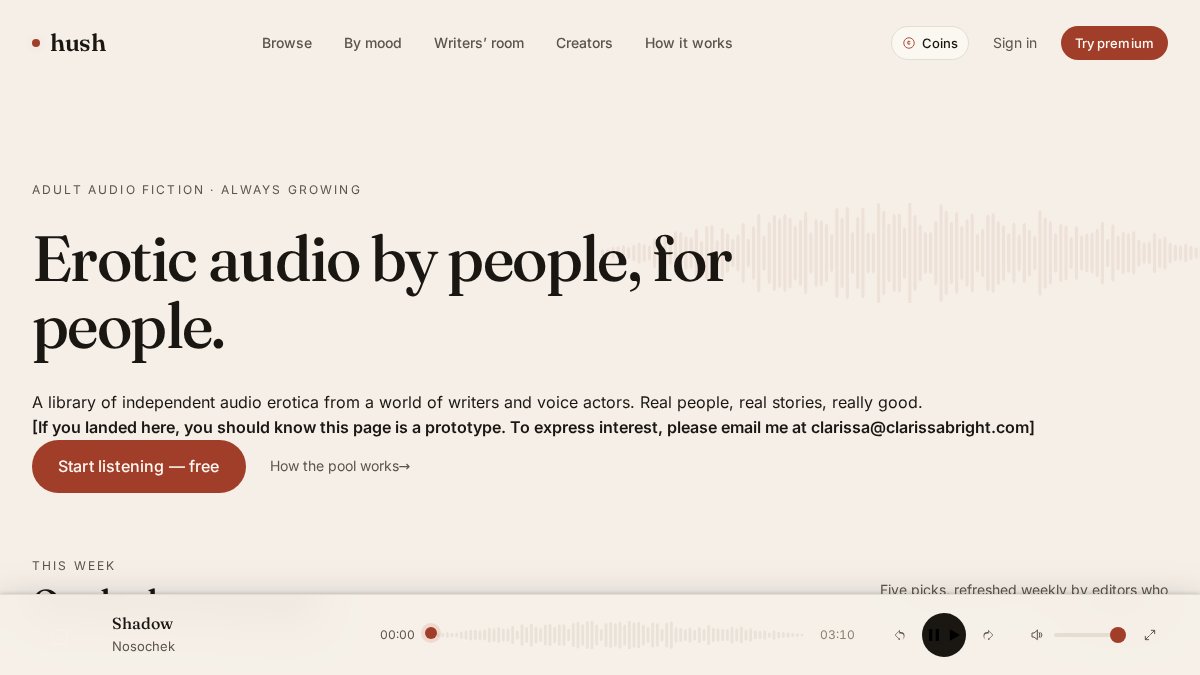
Ferly blends audio erotica with guided wellness sessions, with mood and theme navigation and high production quality. It's as much about sexual confidence and education as the stories themselves, a strength if you want both, a drawback if you came purely for fiction, since the library leans less explicit than dedicated platforms.
Tempt: Trope and Spice-Level Filtering
Tempt goes granular, filtering by specific trope and spice level for "mood readers" who know exactly what they want.
If you've ever wished you could screen out everything below a certain intensity, Tempt's filtering is genuinely useful. No waitlists on popular titles either.
The trade-off: mood browsing takes a back seat to precision filtering, and as a newer platform its library is still growing.
Independent Audio Erotica Platforms and Why They Matter
Independent audio erotica platforms matter because they change who gets paid. On a major audiobook service, your subscription mostly flows to the platform and already-famous authors; on an independent platform, it flows to working writers and voice actors.
What Makes a Platform Independent
Independence isn't about size. It's about who controls the catalog and where the money goes.
A platform counts as independent when it commissions or licenses directly from creators, sets its own editorial standards, and pays creators from subscription revenue rather than one-off buyouts. That last point is the one to check.
Revenue Sharing and Creator Support
Revenue sharing keeps a catalog alive: when creators earn per subscriber rather than per sale, they keep producing and the library stays fresh instead of going stale after launch.
hush pays 70% of subscription revenue to creators. Ask any app you're considering how it pays, and whether that number is published.
Mood-Based Search Functionality: A Deep-Dive
Mood-based search maps stories to emotional states instead of content labels: you choose a feeling, the app surfaces matching narratives, and you refine from there. But "mood browsing" is now a marketing phrase, and many apps use it to describe a handful of renamed tags. Here's how to tell the difference.
The Three Architectures Behind "Mood" Filters
Almost every app claiming mood browsing uses one of three systems. Knowing which one you're looking at tells you how well it will work.
1. Tag renaming. The app relabels existing content tags as moods, "Enemies to lovers" becomes "Tension," "Friends to lovers" becomes "Warm." The catalog doesn't change; the label does. It's the most common approach and the weakest, because the mood still describes content, not feeling.
2. Curated mood collections. An editor hand-picks stories into mood buckets, Slow Burn, Playful, Comfort, Late Night. Quality depends on how often they're refreshed; a stale collection is just a playlist you've already heard.
3. Mood as a primary axis. The catalog is organized around emotional states first, with genre, length, and narrator layered on top. This is the rarest architecture because it requires commissioning or tagging content with mood in mind from the start.
When you open an app, ask which of the three you're looking at. If you can't tell within two minutes, it's probably the first.
A Five-Minute Test You Can Run on Any App
You don't need a subscription to evaluate mood search. Run this on the free tier:
- Pick a mood you can't easily name as a genre. "Restless but not anxious" or "cozy without being sleepy." If the app only offers moods that map one-to-one to genres, it's tag renaming.
- Check the result count. A real mood system returns dozens of titles, not three. Fewer than ten means it's a curated playlist, not a navigation system.
- Look for overlap. Pick two moods that should share stories (Slow Burn and Late Night). Zero overlap means they're just genre buckets with new names.
- Try to layer. Select a mood, then add a genre or narrator filter. If the app resets your mood, mood isn't a real axis, it's a shortcut.
- Check the refresh. Come back in a week. If the same stories top the same mood, the editorial hand isn't active.
Five minutes on the free tier tells you more than any review, including this one.
Mood Categories That Actually Help
Useful mood categories are specific enough to mean something. "Relaxing" is too broad. "Slow burn" and "playful" are not.
Look for categories that describe tone and pacing, not just intensity, a story can be intense and calming at once. The strongest mood taxonomies separate three dimensions:
- Pace, slow burn, propulsive, meandering
- Tone, playful, tender, sharp, wistful
- Intensity, soft, charged, overwhelming
If an app collapses all three into a single list, you'll get mismatches. If it lets you combine them, slow burn plus playful plus soft, you'll find things you couldn't have searched for.
Combining Mood With Genre When You Want Both
If you usually search for specific things you already like, mood browsing doesn't have to replace that. Use genre to narrow, then mood to pick between the results:
- Pick your mood to set the emotional target
- Apply a genre or trope filter to narrow the field
- Sort by length or narrator if you have a preference
- Save what works so the app learns your taste
Done this way, mood browsing sharpens your existing habits instead of disrupting them.
What to Do When Mood Search Fails You
Even a good mood system misses sometimes. A fallback is to search by narrator rather than story: voice can be a reliable mood signal in audio erotica, and a performer whose pacing you like may carry you through a story you wouldn't have picked by tag. Save two or three narrators whose work consistently lands, and check their new releases first.
Technical Audio Quality: What to Listen For
Technical audio quality separates an immersive experience from a distracting one. The two things that matter most are how the audio is mixed and how well the narration is performed. Here's what's happening in the files you're streaming, and how to hear the difference on the headphones you already own.
Binaural Audio and Immersive Soundscapes
Binaural audio is a recording technique that places sound around the listener to create a three-dimensional effect through headphones. It works by recording with two microphones placed in a dummy head or a real listener's ears, so the timing and frequency differences your brain uses to locate sound are captured in the file itself. Done well, a whispered line feels like it's coming from beside you rather than a speaker.
The catch: binaural only works on headphones. Play a binaural track through a phone speaker and the effect collapses into a slightly hollow stereo mix. If a platform advertises binaural audio, test it on the headphones you'll actually use. Not every story needs it, a quiet two-person scene can be more intimate in clean stereo, but for immersive audio, the difference between a flat stereo mix and a proper binaural one is immediate.
ASMR, Whisper Tracks, and When They Help
ASMR-style audio, soft whispers, close-mic breathing, tapping, page turns, overlaps with audio erotica more than most people realize. The same close-mic technique that makes an ASMR video tingle is what makes a whispered line in an erotic story feel physically close.
The trade-off is sensory load: a track layering whisper, breath, ambient room tone, and a music bed can overwhelm a listener who came for the story. Some platforms offer both a fully produced immersive mix and a stripped-back narration-only version. If an app only offers one mix, that's a limitation worth noting.
What to Listen For in the First Thirty Seconds
You can judge a platform's audio quality before you finish the intro. Listen for these five things:
- Room tone. Is there a faint, consistent background, a room, a breath, a hum, or dead silence between lines? Dead silence usually means heavy noise gating, which chops off the tail of words and makes narration sound robotic.
- Plosives and sibilance. Hard P, B, and S sounds should be controlled but not erased. If every S sounds like a lisp, the de-esser is overworked.
- Stereo width. On headphones, does the voice sit in the center with ambient sound spread around it, or is everything crammed into one channel?
- Dynamic range. Can you hear a whisper without turning the volume up, then get through a louder line without turning it down? If you're reaching for the volume slider every thirty seconds, the mix is compressed badly.
- Music bed level. Background music should sit under the voice, not compete with it. If you have to strain to hear the narrator, the mix is wrong.
Voice Acting and Narration Quality
Voice acting carries more weight than any production trick. A skilled performer handles pacing, breath, and tone in ways that make a script land. The same script read by two narrators can feel like two different stories.
What most guides miss is that narration quality varies wildly across a catalog, even within a single platform. A flagship title may be produced to a high standard while newer releases are recorded on a USB mic in a closet. That's not automatically bad; a raw, close recording can feel more intimate than a polished studio one. But you should know which you're getting.
Sample two or three stories before you judge a platform, on the headphones you'll actually use.
Privacy-First Usage: Protecting Your Listening Habits
Privacy-first usage starts with one question: does the app need your data to work, or does it want your data to sell? Audio erotica is personal, and how a platform handles your listening history matters more here than almost anywhere else.
What to Check Before You Subscribe
Run through this before you enter payment details:
- Is there a published privacy policy that names what data is collected?
- Does the app serve ads, and if so, does it build an ad profile?
- Can you delete your listening history?
- Is there a clear cancellation path with no phone call required?
- Does the app require a real name, or will a username do?
An ad-free platform has less incentive to build a behavioral profile, because there's no advertiser to sell it to. That's a structural advantage, not just a nice feature.
Discreet Listening on Shared Devices
Shared devices are the practical risk most people overlook. A synced library or visible download list can out you faster than any data breach.
Neurodivergent-Friendly Listening and Accessibility
Neurodivergent-friendly listening comes down to control: over volume, speed, and how much sensory input you take in at once. A platform that respects those controls is easier for everyone, not just listeners with specific needs.
Sensory Considerations in Audio Erotica
Sensory experience is the whole appeal of audio, but the same intensity that works for one listener can overwhelm another. Binaural mixes, layered soundscapes, and ASMR-style whisper tracks all hit differently.
Playback Controls That Reduce Overwhelm
Playback controls are the accessibility feature people actually use. Look for:
- Variable playback speed, including slower-than-normal
- A sleep timer that fades out rather than cutting off
- Per-story volume that doesn't reset between titles
- Short-episode options when a full-length story is too much
Pricing, Subscriptions, and Free Options
Pricing for audio erotica apps generally follows a subscription model, with free tiers that vary widely in what they unlock. Because plans change often, check each app's own site for current numbers rather than trusting a comparison written months ago.
Subscription Models Compared
Most platforms fall into one of three shapes:
| Model | How It Works | Watch Out For |
|---|---|---|
| Flat monthly | One fee, full library access | Auto-renewal terms |
| Freemium | Free tier plus paid unlock | Limited free catalog |
| Per-title | Pay for individual stories | Costs add up fast |
A flat monthly fee is usually simplest to budget, and can align well with revenue-sharing models, since your subscription supports creators continuously rather than per purchase.
What Free Tiers Actually Include
Free tiers are a test drive, not a substitute. They typically give you a rotating selection or a limited number of stories per period.
Content Variety and Genre Diversity
Content variety determines how long a subscription stays interesting. A catalog can be large and still feel narrow if every story follows the same arc with the same kind of narrator.
Frequently Asked Questions
How do mood-based audio erotica apps differ from traditional tag-based platforms?
Tag-based platforms make you search by genre labels like 'romance' or 'historical,' which describe what the story is about but not how it feels. Mood-based apps let you browse by emotional state instead: 'unwind,' 'feel desired,' 'escape,' or 'feel powerful.' This matters because the same genre can deliver very different experiences. A mood-first interface narrows the gap between what you want to feel and what you actually find, reducing the trial-and-error of clicking through stories that technically match a tag but miss the point.
Are there audio erotica apps that prioritize independent creators?
Yes. Independent audio erotica platforms like Hush focus on building a library from independent writers and voice actors rather than licensing mass-market content. Hush pays 70% of subscription revenue directly to creators, which is a higher share than most mainstream audiobook platforms offer. This model means the catalog tends to feature more experimental, narrative-driven work and diverse perspectives. You can verify a platform's creator commitment by checking whether it publishes its revenue-share terms publicly.
Is it possible to find ad-free audio erotica experiences?
Ad-free listening is available on several dedicated audio erotica apps, including Hush, which offers an ad-free experience as part of its subscription. Free tiers on some platforms may include ads or limited content. If ad-free access matters to you, check whether the platform's paid tier explicitly removes ads and whether the free tier is ad-supported. Most subscription-based services in this category keep the paid experience clean.
What should I look for in a high-quality audio erotica app?
Prioritize four things: how you browse (mood-based filtering beats rigid tags), audio production quality (binaural sound and skilled voice acting make a noticeable difference), privacy practices (look for clear data policies and no ad-tracking), and content freshness (weekly updates prevent library fatigue). Also check the subscription terms. A flat monthly fee with easy cancellation and a free tier to test the experience first can be a good option. Hush offers all of these, including editor-refreshed content weekly.