 how-to
How to Identify Professional Voice Acting: 2026 Guide
Table of Contents
- What Separates Professional Voice Acting From Amateur Work
- Voice Acting Performance Techniques That Signal Real Training
- Professional Voice-Over Audio Quality Standards to Listen For
- Voice Actor Emotional Range Examples: How to Spot Genuine Delivery
- The Psychology of Sound: Why Professional Voice Acting Feels Different
- Equipment and Hardware: What Professional Voice Actors Actually Use
- How to Evaluate Voice Acting on Streaming Platforms and Audio Fiction
- Conclusion
- Frequently Asked Questions
Last Updated: September 17, 2026
What Separates Professional Voice Acting From Amateur Work
The clearest sign of professional voice acting is control you never notice. A trained performer manages breath, pitch, and pacing so smoothly that the listener hears only the story, not the effort behind it. Amateur work usually reveals itself through strain, uneven levels, or delivery that sounds read rather than felt.
That distinction matters more than ever in 2026. Audio fiction and spoken-word entertainment have moved from niche hobby to serious subscription category, and listeners now compare everything against studio-grade production. This guide from hush breaks down exactly what to listen for, whether you're a creator vetting talent or a listener deciding where your subscription dollars go.
Professional voice acting is the trained craft of delivering scripted audio with controlled technique, clean recording quality, and genuine emotional range, so the performance serves the story instead of drawing attention to itself.
Three things separate the pros from everyone else: technique, audio quality, and emotional range. Miss any one of them and the illusion collapses. Below, we'll show you how to test each one in under a minute of listening.
Voice Acting Performance Techniques That Signal Real Training
Breath control is the fastest tell. Trained performers rarely audibly inhale mid-sentence, and when they do, it's placed deliberately for emphasis. Amateurs gasp, run out of air at line endings, and let volume drop as their breath fades.
Mic technique is the second signal. A professional maintains consistent distance from the capsule, which keeps volume steady and prevents the proximity effect from making some words boom while others recede. You'll hear this as a smooth, even tone across an entire episode.
Pacing rounds out the trio. Strong performers vary tempo to match the emotional beat: slower for tension, quicker for excitement, with clean pauses that let a line land. Flat, metronomic delivery usually means someone is reading rather than performing.
Professional Voice-Over Audio Quality Standards to Listen For
Clean audio is non-negotiable, and it's the easiest thing to check. Put on headphones and listen for room tone between lines. A professional recording has a quiet, consistent background. Amateur files hum, hiss, or capture traffic and keyboard clicks.
Plosives are the second giveaway. Words starting with "p" and "b" should land softly, not as a burst of air hitting the mic. Trained performers angle the microphone slightly off-axis or use a pop filter to tame that spike. If every "pop" makes you flinch, the recording wasn't handled with care.
Room treatment matters just as much. Hard, untreated walls create a boxy echo that no amount of editing fully removes. Professional voice-over audio quality standards start with a treated space: absorption panels, a reflection filter, or at minimum a soft, furnished room.
Voice Actor Emotional Range Examples: How to Spot Genuine Delivery
Genuine emotional range shows up in the small choices, not the big ones. Listen for how a performer handles a shift from calm to tense. A skilled actor changes breath rhythm, pace, and vocal weight together. An untrained one just gets louder.
Here's what that sounds like in practice. In a suspense scene, a professional might drop to a near-whisper and slow down, pulling the listener closer. In a warm, intimate moment, the same performer softens consonants and lets sentences breathe. The contrast between those two moments is where training becomes obvious.
The real difference between a good and a great performance comes down to restraint. Beginners oversell every line. Professionals trust the writing and let silence do part of the work. If a performer can make you feel tension without raising their voice, you're listening to someone who has put in the hours.
The Psychology of Sound: Why Professional Voice Acting Feels Different
Professional voice acting feels different because it works with how your brain processes sound, not against it. Human hearing is wired to detect subtle shifts in tone and rhythm, and trained performers use those shifts intentionally to guide attention and emotion. Most guides stop there. The more useful question is why certain frequencies and patterns relax a listener while others create friction, and that answer lives in a handful of well-documented auditory mechanisms.
The frequency range of the human voice is narrow, and that matters. Fundamental speaking pitches for adults sit roughly between 85 Hz and 255 Hz, with most intelligibility carried in the 1 kHz to 4 kHz range. That 2 kHz to 5 kHz band is where the ear is most sensitive, an evolutionary leftover from needing to detect distress calls and approaching threats. When a voice actor's track has an uncontrolled spike in that band, the listener's nervous system reads it as urgency even if the words are calm. Professional mixing tames those spikes with gentle compression and de-essing so the voice stays warm instead of piercing.
Binaural beats are a different tool entirely. When two slightly different frequencies are played separately to each ear, say 200 Hz on the left and 210 Hz on the right, the brain perceives a rhythmic pulse at the difference, in this case 10 Hz. That 10 Hz falls in the alpha range associated with relaxed wakefulness. Binaural beats require headphones to work; on speakers the effect largely disappears because both ears hear both tones. Some audio fiction and meditation productions layer low-volume binaural tones under narration to nudge listeners toward a calmer state, though the research on how strong the effect is remains mixed.
The 432 Hz vs. 440 Hz debate is worth understanding, even if the science is unsettled. Standard concert tuning in the U.S. is A=440 Hz (Time and Frequency from A to Z | NIST). A popular alternative tuning uses A=432 Hz, which proponents claim sounds warmer and less fatiguing. Controlled studies have not consistently shown a physiological difference, but the perceptual preference some listeners report is real, and for a voice actor, the practical takeaway is that pitch and timbre choices affect how a performance lands, whether or not a specific number is magic.
Why does any of this matter for spotting a pro? Because trained performers and engineers shape these variables on purpose. They ride gain to keep the 2-5 kHz band controlled, they place breaths so they don't interrupt the rhythm the brain is tracking, and they vary pace to match the emotional arc rather than delivering a flat stream. Amateur tracks often have the opposite profile: sharp transients, uneven low-end, and pacing that fights the listener's attention instead of guiding it.
Sound therapy research points in the same direction: consistent, controlled audio supports relaxation, while chaotic or poorly balanced sound creates friction. Professional performers and engineers understand this instinctively. They shape every line so the listening experience stays smooth from start to finish, and once you know which frequencies and patterns are doing the work, you can hear the difference in seconds.
Equipment and Hardware: What Professional Voice Actors Actually Use
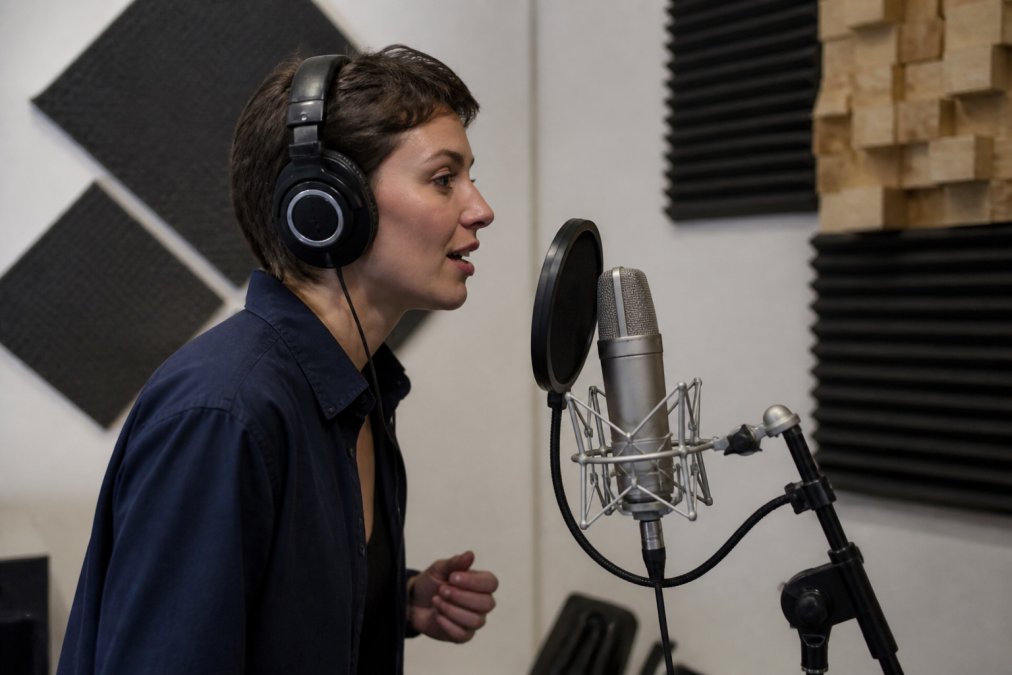
You can often hear the equipment before you can name it. Most professional voice actors work with a large-diaphragm condenser microphone, an audio interface with a clean preamp, and closed-back headphones for monitoring. That chain captures detail without adding noise. But the specific gear matters less than the signal chain, and the signal chain matters less than the room.
The microphone. Large-diaphragm condensers are the studio standard because they capture the full detail of a voice. Common workhorses include the Neumann TLM 103, the Audio-Technica AT4040, and the Rode NT1. Dynamic microphones like the Shure SM7B are also popular in voice work because they reject room noise and handle plosives gracefully, at the cost of some high-frequency air. A performer's choice here tells you what they're optimizing for: detail or isolation.
The interface and preamp. A clean preamp is what keeps a quiet performance quiet without introducing hiss. Entry-level interfaces like the Focusrite Scarlett series and the Audient iD series are common in home studios; higher-end chains use dedicated preamps. The practical difference you'll hear is the noise floor, how much hiss sits under the silence between lines.
The headphones. Closed-back monitoring headphones (the Audio-Technica ATH-M50x and Sony MDR-7506 are near-universal in voice work) let a performer hear their own voice without bleed from speakers. This matters because performers need to catch their own plosives and breath placement in real time.
The room does more work than the gear. Acoustic foam, bass traps, and a reflection filter control how sound bounces before it ever reaches the mic. A modest microphone in a treated room beats an expensive one in a bare bedroom every time. The reason is simple: a mic captures the room as much as the voice, and hard parallel walls create standing waves that no amount of post-processing fully removes.
How to Optimize Your Own Listening Setup
Hardware optimization is one of the angles most guides skip. Listeners rarely think about it, but it explains why two performers with similar skill can sound worlds apart. If a track sounds thin, boxy, or distant, the recording environment is usually the culprit, not the talent. Here's how to get the most out of whatever you're listening on:
- Use wired headphones when you can. Bluetooth codecs like SBC and AAC compress audio, and the compression is most audible in the midrange where voices live. Wired over-ear headphones or wired earbuds preserve the detail that distinguishes a clean track from a noisy one.
- Turn on noise cancellation, or don't. Active noise cancellation (ANC) is great for blocking traffic and HVAC rumble, but some implementations add a faint hiss or pressure sensation that can mask the very room tone you're trying to evaluate. If you're auditioning a track for production quality, try it with ANC off first.
- Match your volume to the source. Loudness normalization on streaming platforms means two tracks can have very different dynamic ranges at the same perceived volume. Listen at a moderate level, around the volume of a normal conversation, so quiet details stay audible and loud peaks don't fatigue you.
- Check your EQ settings. Many phones and computers ship with bass-boost or 'spatial audio' presets enabled by default. These color the sound and make it harder to judge the source. Flat EQ is the honest setting.
- Listen on two systems. A quick A/B between headphones and a decent speaker reveals problems that either alone might hide, boxiness shows up on speakers, plosives show up on headphones.
Once your own chain is clean, the gear a performer uses becomes audible as a choice rather than a mystery. You'll start to hear why one voice sounds intimate and close-mic'd while another sounds like it's in a larger space, and you'll be able to tell whether that space was chosen or just whatever room was available.
How to Evaluate Voice Acting on Streaming Platforms and Audio Fiction
Platform quality varies enormously, so evaluate the same way every time. Start with a two-minute sample, listen on headphones, and score the performance against the three pillars: technique, audio quality, and emotional range. Consistent scoring beats gut feeling.
Curated, ad-free platforms tend to invest more in production because the experience itself is the product. That's the approach we take at hush: every story is reviewed by editors, and 70% of subscription revenue goes directly to the writers and voice actors behind it. When creators are paid fairly, they can afford the time and equipment that professional voice acting requires.
Use this quick reference to spot problems fast:
| What You Hear | Likely Cause | What It Means |
|---|---|---|
| Audible gasps mid-sentence | Weak breath control | Untrained performer |
| Booming "p" and "b" sounds | Plosives, no pop filter | Poor mic technique |
| Boxy echo on every line | Untreated room | Low production budget |
| Flat, metronomic delivery | Reading, not performing | No emotional range |
| Volume dips at line ends | Fading breath support | Amateur recording |
Red Flags in Amateur Voice-Over Work
The biggest red flag is inconsistency. A professional sounds the same at minute one and minute twenty. Amateurs drift: volume wanders, energy flags, and background noise changes between takes. Random edits and mismatched room tone are dead giveaways that a project was rushed.
A second red flag is overacting. Beginners push emotion into every syllable, mistaking volume for feeling. Genuine delivery is measured. If every line sounds like a dramatic climax, you're not hearing a performance, you're hearing someone try.
Conclusion
Spotting professional voice acting comes down to three things you can test in any two-minute sample: controlled technique, clean audio, and real emotional range. Once you know what to listen for, mediocre production is impossible to unhear.
That standard is exactly what hush was built around. Our library of independent audio erotica is curated and refreshed weekly by editors, filterable by mood rather than rigid tags, and completely ad-free. With 70% of subscription revenue paid to the writers and voice actors, you're hearing creators who had the time and support to do the work properly. Start listening free and hear the difference for yourself.
Frequently Asked Questions
What are the characteristics of professional voice acting?
Professional voice acting combines three elements: trained performance techniques, clean audio quality, and genuine emotional range. You will hear consistent breath control, no mouth clicks or plosives, and natural pacing that matches the script's intent. Professional voice actors also adapt their tone across scenes without sounding forced. When evaluating audio fiction, listen for how the actor handles transitions between dialogue, narration, and emotional beats. If the delivery pulls you into the story without distracting artifacts, you are likely hearing professional work.
How can you tell if a voice actor is experienced?
Experience shows in subtle ways. Experienced voice actors vary their pacing, use silence effectively, and avoid the monotone delivery common in amateur recordings. They also handle difficult passages, like whispered lines or emotionally charged scenes, without losing audio clarity. Another signal is consistency: an experienced actor maintains the same character voice and energy level across an entire story, not just the first few minutes. On curated platforms, editorial teams often screen for these qualities before publishing.
What technical qualities define professional audio production?
Professional voice-over audio quality standards include a low noise floor, meaning no hiss, hum, or room echo. Plosives (harsh p and b sounds) are controlled, and sibilance (sharp s sounds) is tamed without sounding dull. The recording sits at a consistent volume level throughout, with no sudden spikes or drops. Professional productions also use light compression and EQ to keep the voice warm and present. If you hear background traffic, keyboard clicks, or uneven levels, the production likely skipped professional audio standards.
Why does voice acting quality matter for immersive storytelling?
Audio fiction depends entirely on the voice to build atmosphere, tension, and intimacy. Poor audio quality or flat delivery breaks immersion instantly. When voice acting is professional, listeners forget they are hearing a recording and feel present in the story. This matters especially for mood-based or erotic audio, where emotional nuance and vocal texture carry the experience. Platforms that curate their libraries and pay creators fairly tend to attract stronger voice talent, which directly improves how immersive each story feels.